Engagement at a glance
(4–6 → 9–12 cars)
(17% → 24%)
(SGD 83 → SGD 51)
(was ~60 min)
(400 → 1,060+)
Monthly revenue roughly doubled over the engagement window, with no headcount added on the operations side.
The business before automation
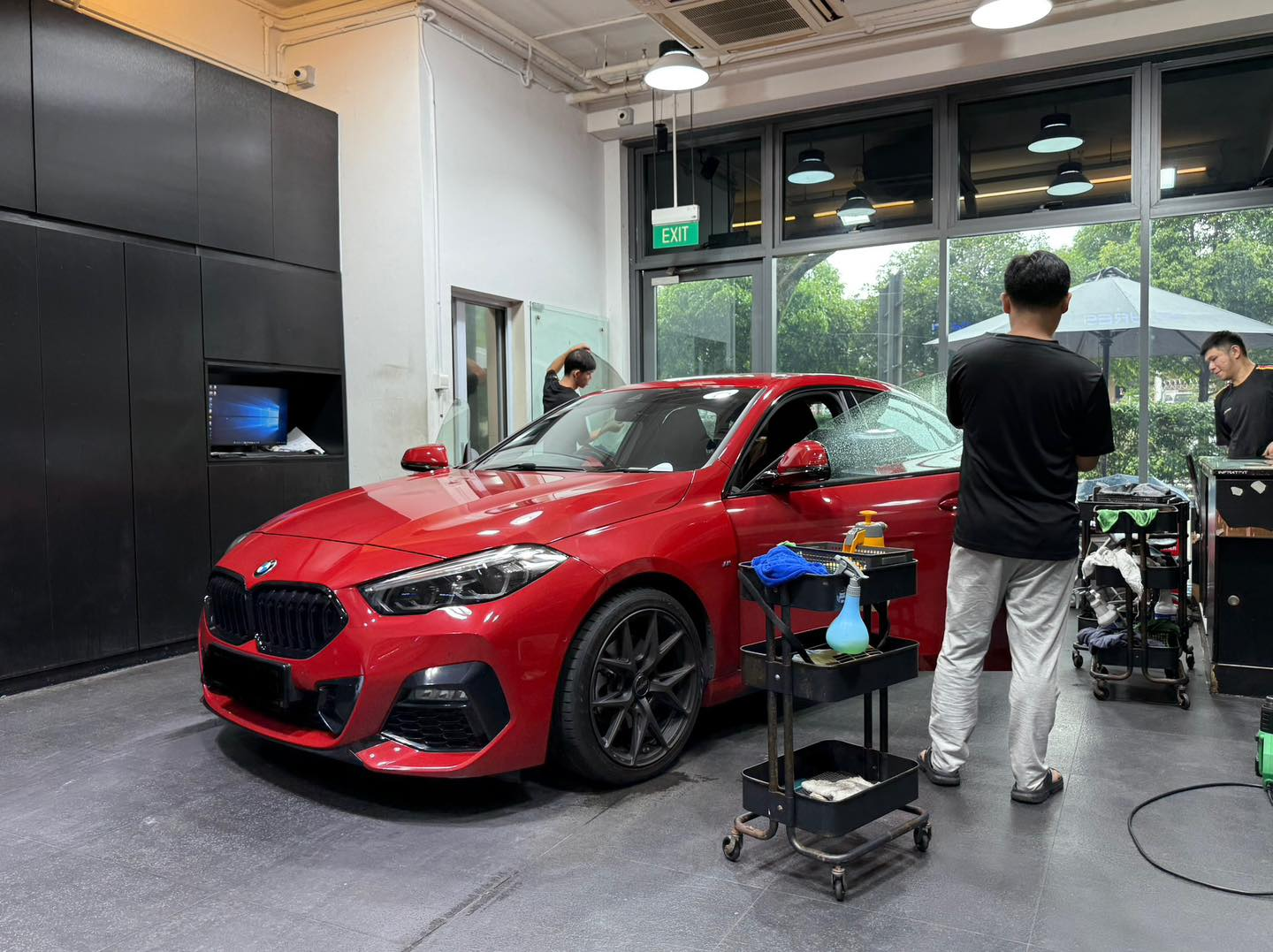
Infratint installs premium automotive window tints in Singapore. Five people: four technicians, one service manager. Walk into the workshop on any given Wednesday and you'd see a queue of cars, a few customers waiting in the lounge, and one phone — a single personal WhatsApp inbox — buzzing constantly with bookings, quotes, LTA-compliance questions, repeat-customer follow-ups, and warranty queries.
The business was healthy. The problem was that all of its growth was bottlenecked through that one phone.
The four problems we set out to fix
- Customer acquisition cost was creeping up at the same ad spend. The ads were working; what came after the click wasn't.
- WhatsApp overload. Response times ranged from minutes to hours, and the manager was answering messages between car installations rather than running the bay.
- Manual booking was the bottleneck. Every appointment required several rounds of back-and-forth before a slot was confirmed.
- Follow-ups slipped. Upsells, reviews, and renewals existed in theory but rarely in practice — there was nobody whose job it was to send them.
Why WhatsApp, not SMS or email
Before any tooling discussion, we wanted to be sure we were betting on the right channel. The numbers in Singapore make this an easy call:
- 74.7% of Singapore's social-media users name WhatsApp as their most-used platform.
- 98% open rate on WhatsApp messages, against ~20% for promotional email and a similar range for SMS.
- 2.5 billion monthly active users globally — most of whom check it dozens of times a day.
- Service conversation charges removed by Meta on 1 November 2024, mid-engagement, which lowered the marginal cost of every utility message we sent.
- Cultural fit. Asian consumers default to chat over email for service businesses. Trying to push them to a web form is friction tax we don't need to pay.
SMS was evaluated and rejected: higher per-message cost, 160-character limits, iOS/Android routing to "Unknown Senders" or spam, weak compliance and opt-in enforcement, and limited reporting. Reach alone (98% vs. ~20% open) made the decision before the cost analysis even mattered.
Tooling: respond.io
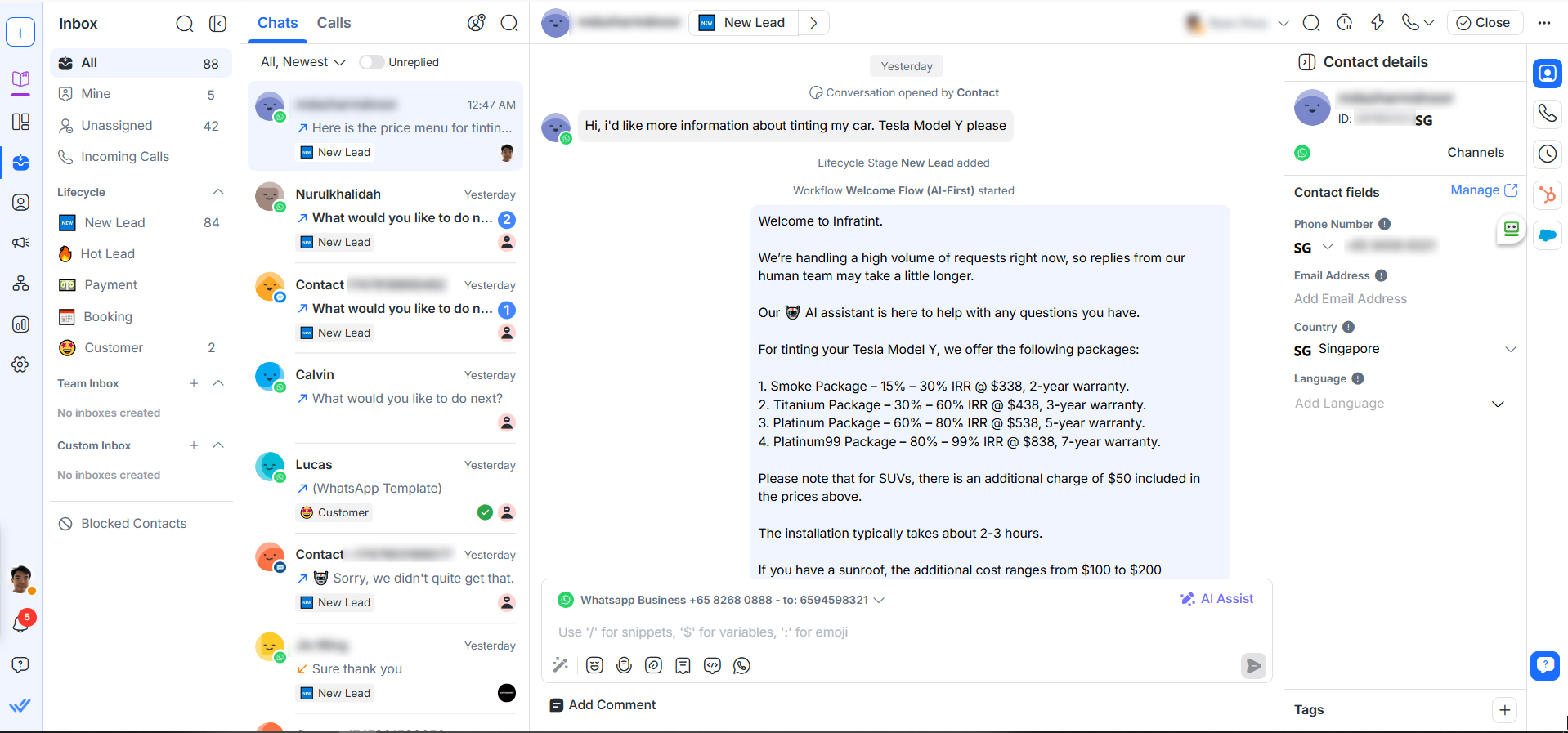
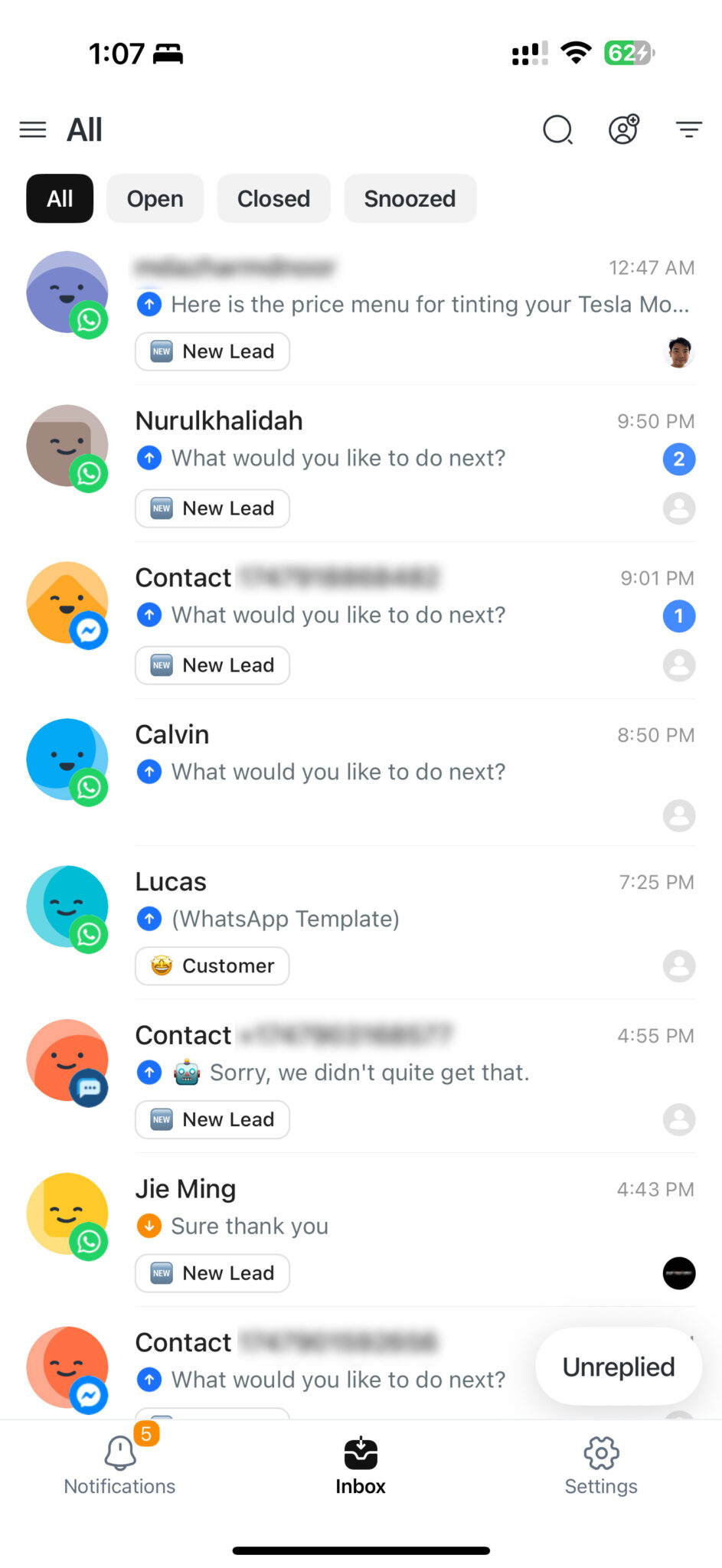
We deployed on respond.io. The interface mirrors consumer WhatsApp closely enough that staff onboarded with two training sessions and a week of shadowing — full competency by day three. For a five-person team, the tool you pick has to fit the workflow already in their hands; anything that asks them to learn a new mental model is a tax that gets paid in slower replies forever.
The build, in three layers
1. WhatsApp + CRM, on one rail
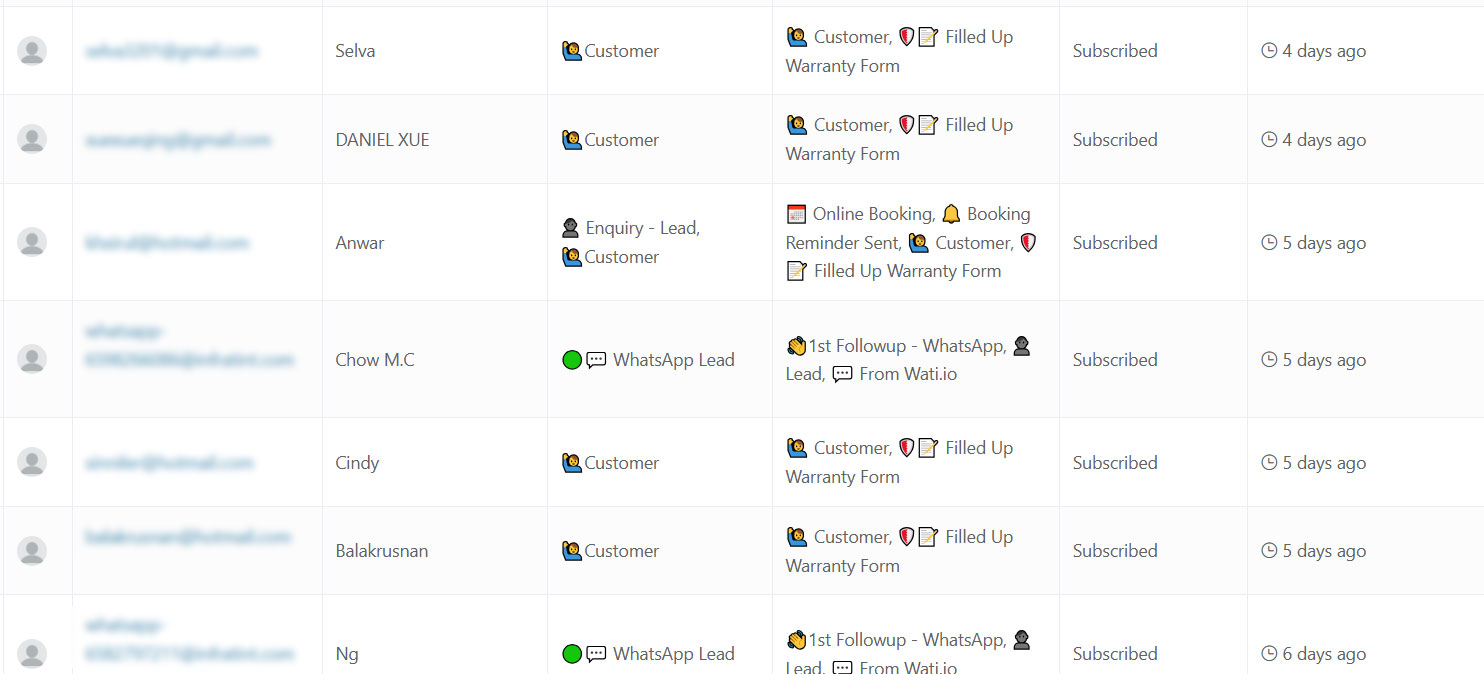
Every inbound message — WhatsApp, web forms, Facebook Messenger, Instagram DMs, website chat widget, email — was unified into a single CRM record. The contact, the conversation history, the booking, the spend at point-of-sale, all on one timeline. No more "channel hopping" while a customer waits for an answer. The point-of-sale system synced nightly, so the moment a customer paid for an installation, that spend showed up against their WhatsApp profile.
2. A 24/7 AI chatbot for the FAQ layer
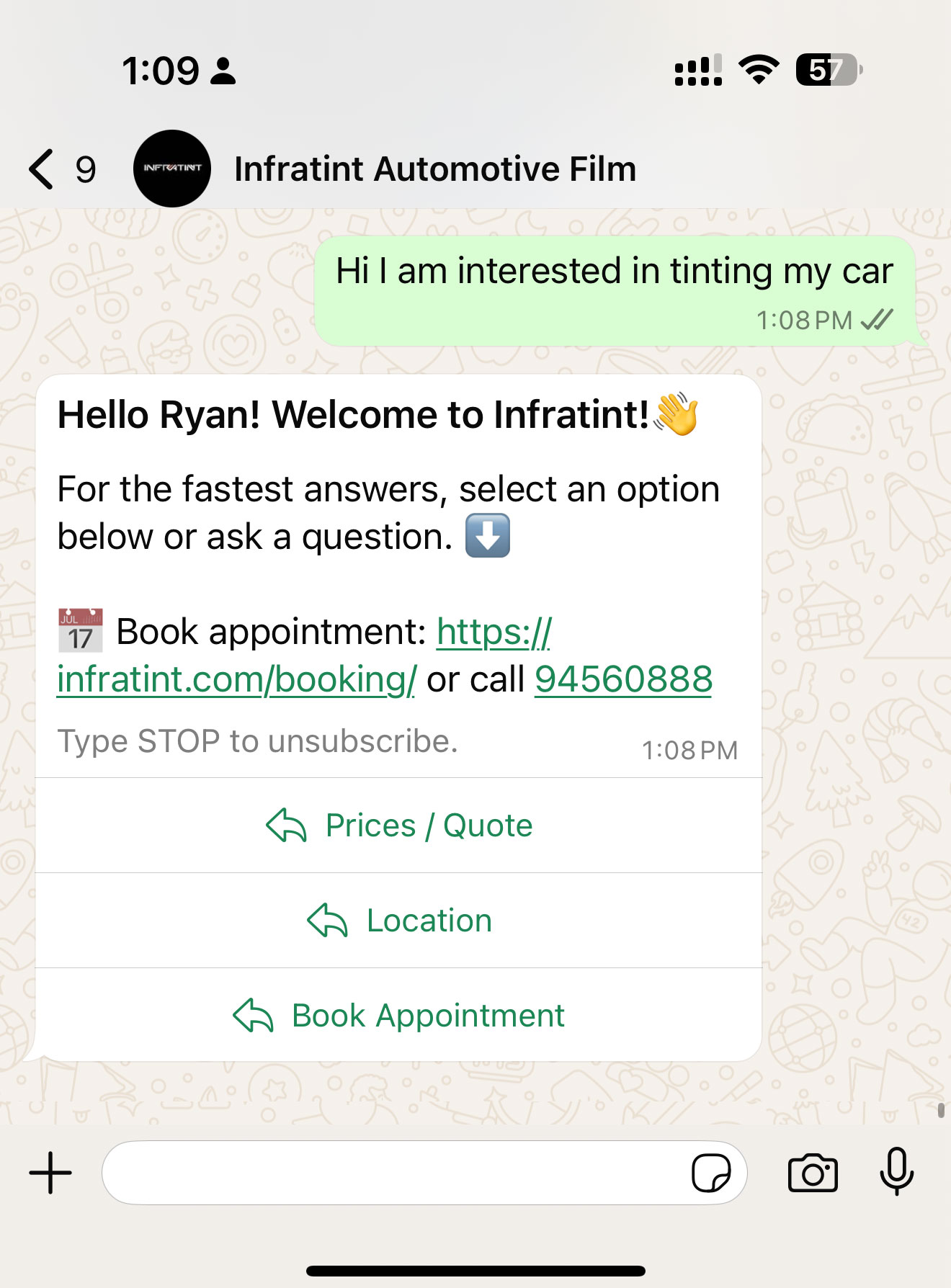
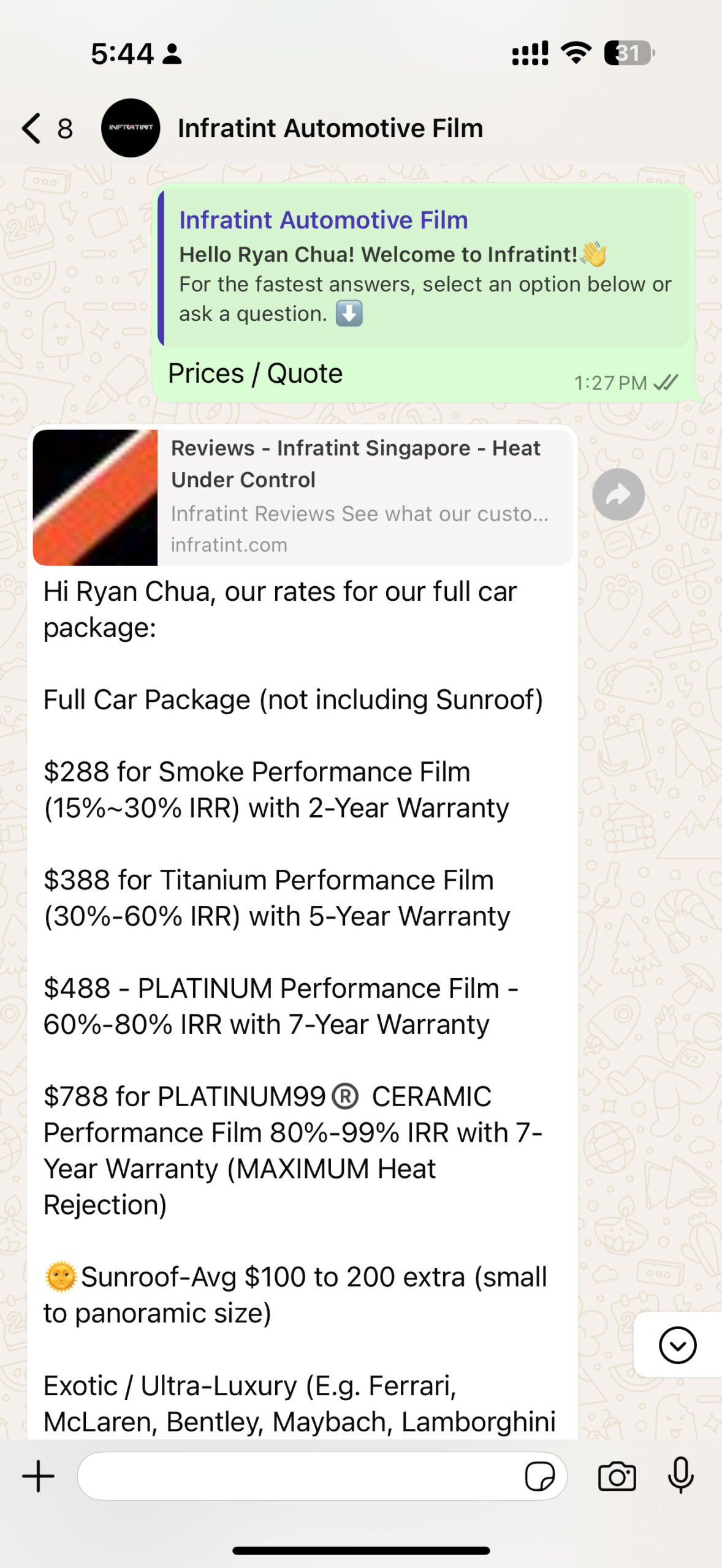
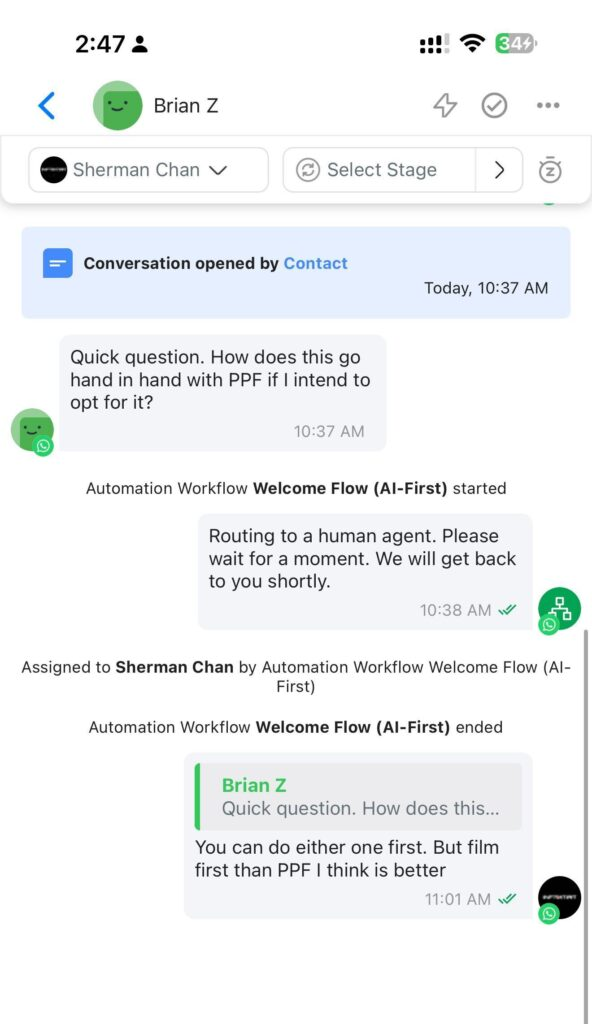
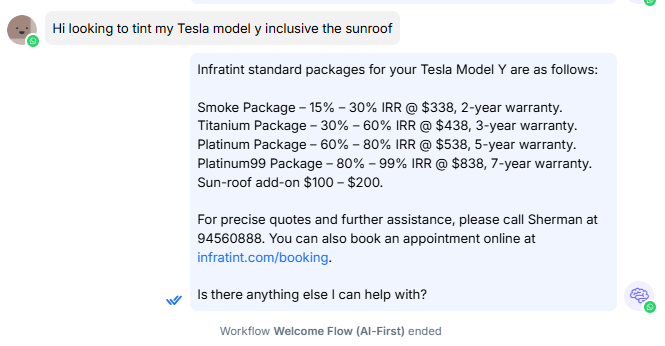
The chatbot handled the predictable 80% of inbound: pricing ranges, LTA-compliance verification (a recurring question for any tint shop in Singapore), booking availability, warranty terms. It captured vehicle model, preferred dates, and contact details up front, then escalated anything complex to a human with that context already attached. After-hours inquiries were offered a callback slot rather than dropped.
Average first-response time: under 10 seconds. The previous baseline was roughly 60 minutes during business hours and "tomorrow morning" outside them.
3. 25+ automated lifecycle workflows
The least visible layer, the one that did most of the work:
- Booking confirmations on WhatsApp the moment a slot is taken.
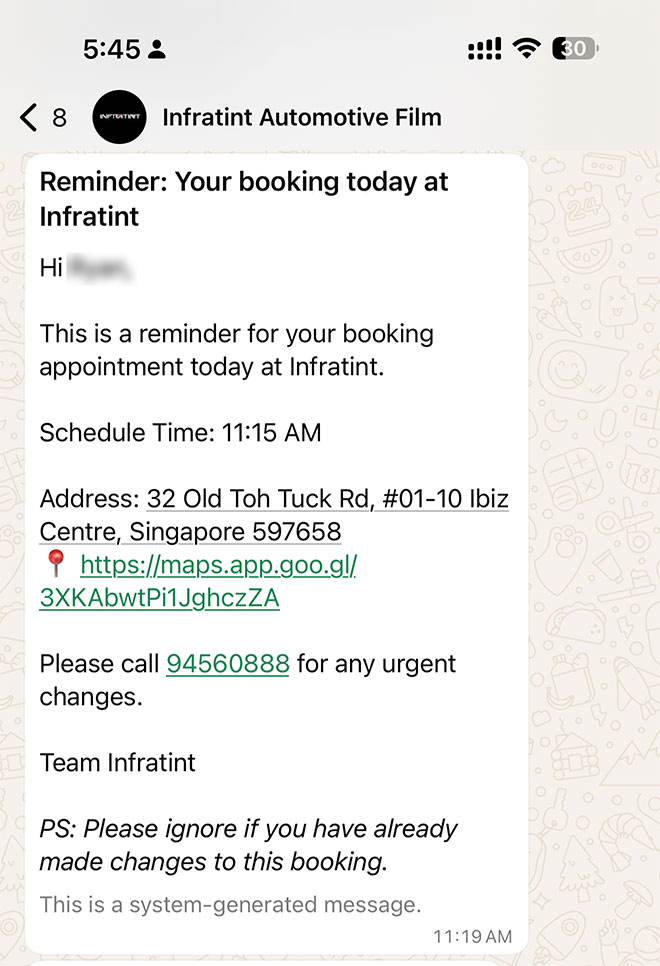
- Appointment reminders at 24 hours and 1 hour before service.
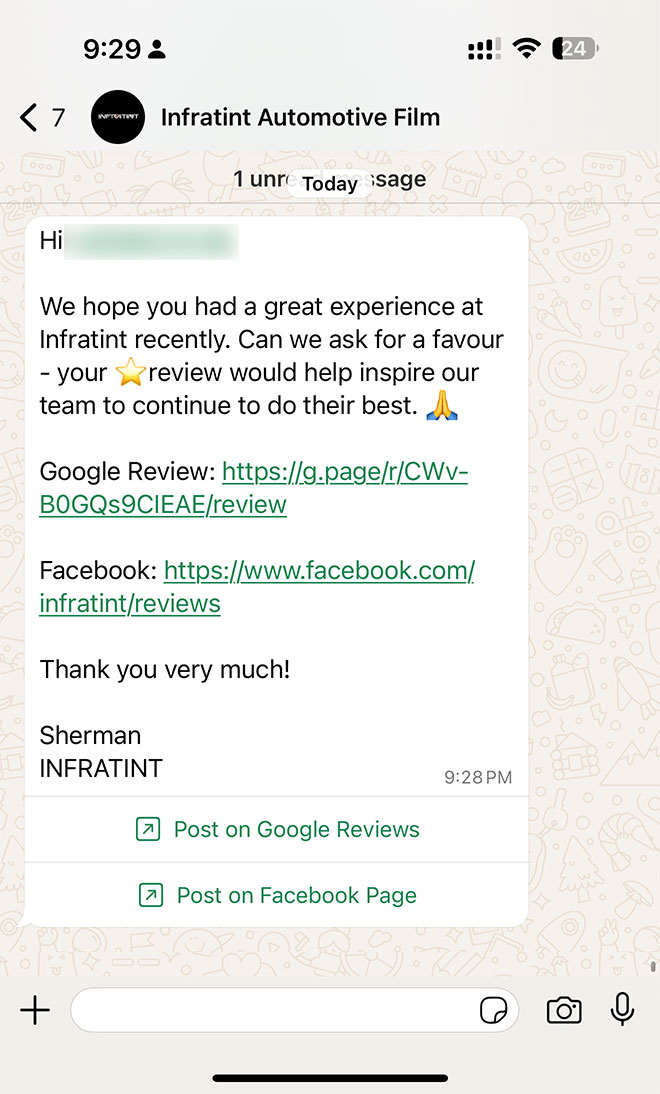
- Post-service review requests sent five days after completion.
- Service-interval nudges for renewals and re-tinting.
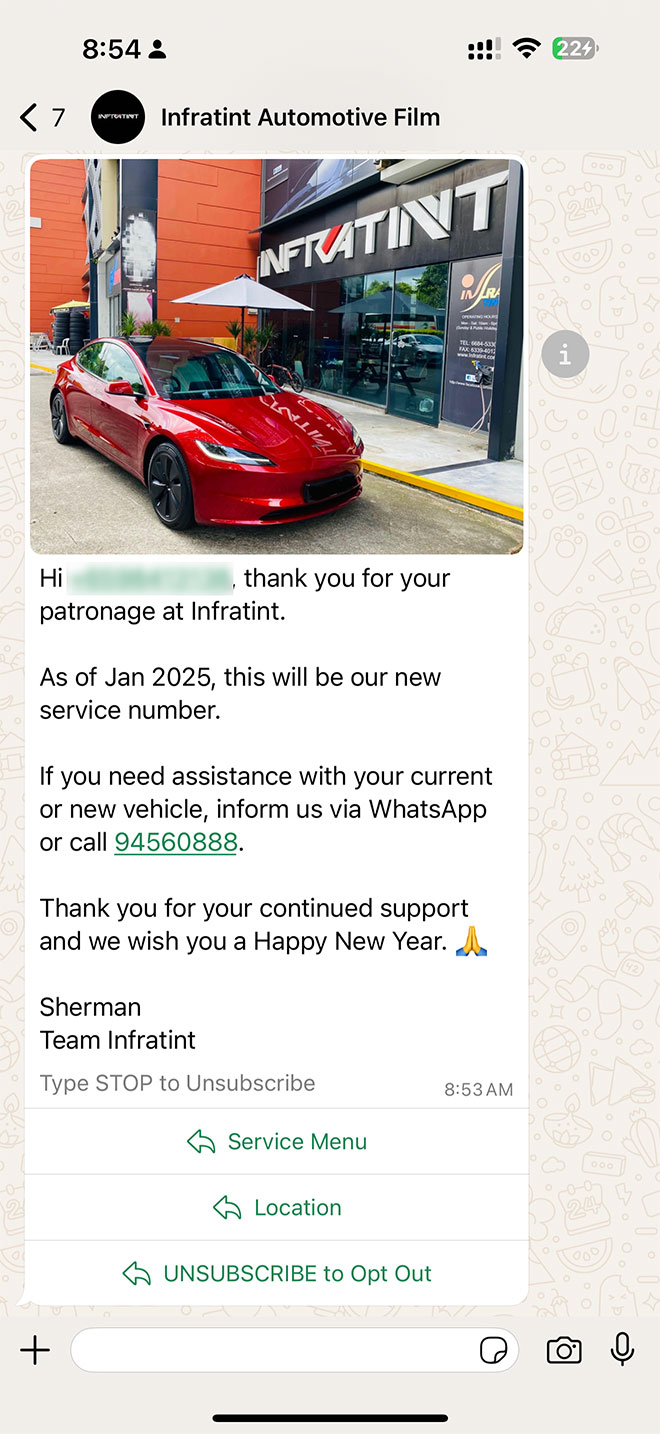
- Daily morning briefings to the service manager's WhatsApp with the day's appointments.
- Email mirrors of the same notifications via the CRM, so nothing was lost if a customer's WhatsApp was muted.
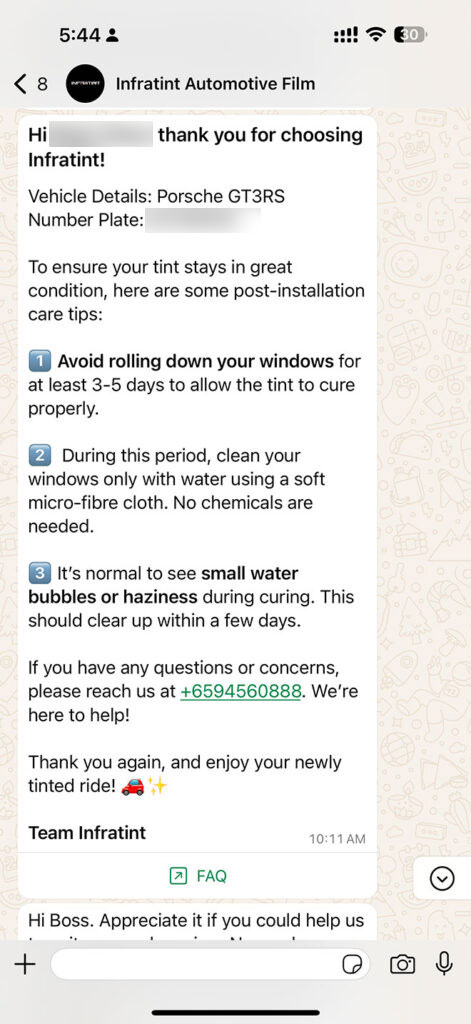
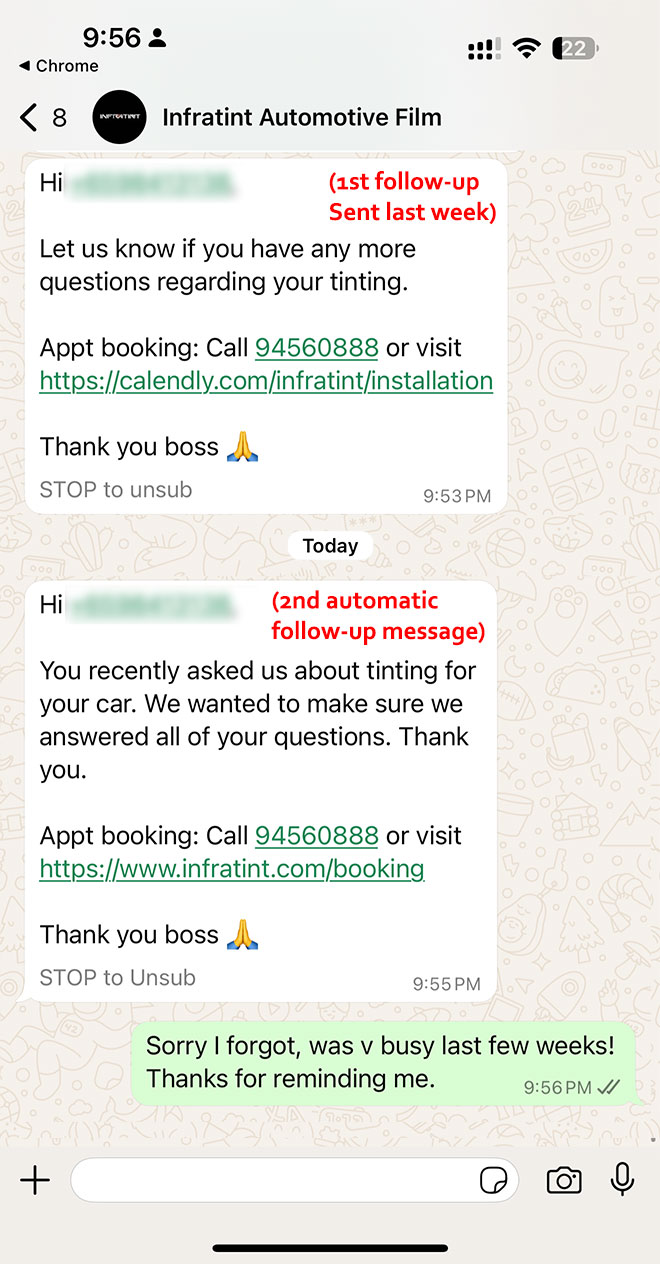
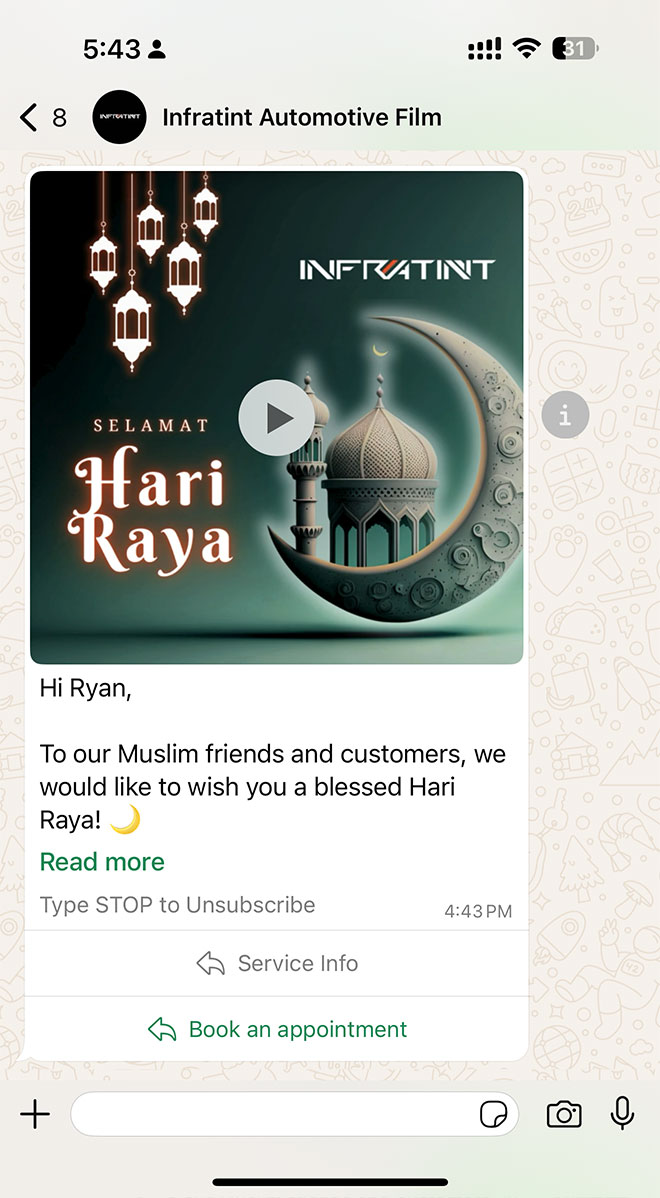
We deliberately led with value-driven utility messages — service updates, appointment reminders, tint care tips, warranty information — for the first weeks. Marketing broadcasts came later, after trust on the channel was established. This matters: open the relationship with a sales pitch and you train the customer to mute you. Open it with something useful and the broadcast you send three months later actually gets read.
Operational changes that mattered
Self-service booking
A mobile-optimised booking interface synced to the workshop calendar. Customers picked their own slot. The system fired the WhatsApp confirmation to the customer and an alert to the manager. The manager's role shifted from "schedule cars all morning" to "look at the day's manifest at 8am and run the bay."
Reactivating 10,000+ legacy customers
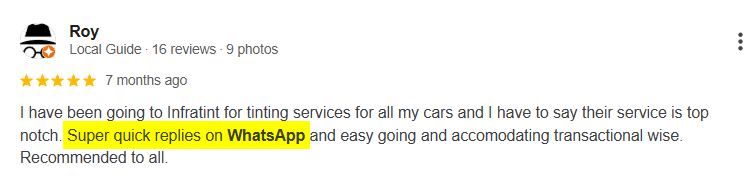
Infratint had a database of more than 10,000 historic customers. Most had never been spoken to since the day they paid. We sent a single introductory message announcing the new WhatsApp support number, with a menu of next-step options.
- 15% of recipients engaged with menu options.
- ~3% inquired about pricing or availability.
- Below 5% opt-out rate.
That is real revenue at zero acquisition cost. Subsequent monthly broadcasts to this base achieved roughly a 2.5% re-booking rate — about 250 repeat appointments per send.
Follow-up sequences for unconverted leads
Multi-day automated follow-ups for the people who inquired but didn't book on the first conversation. Gentle reminders, testimonials, links to tint options, current availability. Most leads don't book on the first message; they book on the third or fourth touch — only if those touches actually happen.
Review automation
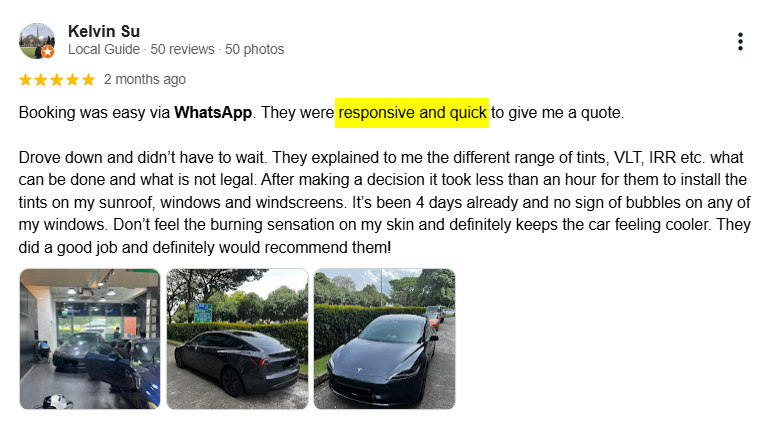
Pre-launch, Infratint received roughly two reviews a week. Post-launch, a templated WhatsApp request five days after each service pushed that to 15+ reviews per week. Six months later, total reviews had climbed from 400 to over 1,060. Every one of those is social proof that compounds against future paid spend.
Marketing broadcasts — one per month, value-led
One carefully timed, value-focused broadcast per month after the trust window. Festive tips, solar-film care guides, seasonal offers — each with a one-tap opt-out. Monthly cadence, not weekly. Discipline on this is the difference between a healthy list and a burned-out one.
How we measured the numbers
It's worth showing the working, because the temptation in case studies is to round up.
Conversion rate (17% → 24%, +40% relative)
Definition: booked installations ÷ qualified enquiries (leads that completed the chatbot prompts or submitted a web form, plus responded to follow-up).
Window: September 2024 (pre-launch) vs. December 2024 (post-launch). 30-day periods.
Customer acquisition cost (SGD 83 → SGD 51, −38%)
Definition: paid media spend (Meta + Google) ÷ first-time customers, excluding repeat and organic referrals.
Window: Q3 2024 average vs. Q1 2025 average.
Response time (~60 min → <10 sec)
Average first-response time, measured from inbound message timestamp to first outbound reply (chatbot or human). The order-of-magnitude shift is what mattered; the exact number is a function of the chatbot fielding the bulk of inbound.
No-shows (−35%)
Driven entirely by the 24-hour and 1-hour appointment reminders. No-shows in a five-person workshop are unusually expensive — an empty bay is an unbillable hour you can't sell elsewhere — so this number translated directly to revenue.
What the operator saw
"Thanks to your system, we saved much time following up on WhatsApp. Really made life easier for us."
— Sherman Chan, Owner, Infratint
By month six, Sherman was openly considering facility expansion to push toward 18–20 cars a day. The constraint had moved from "can we handle the inbound" to "do we have the physical bays to install at this rate." That's the right kind of problem.
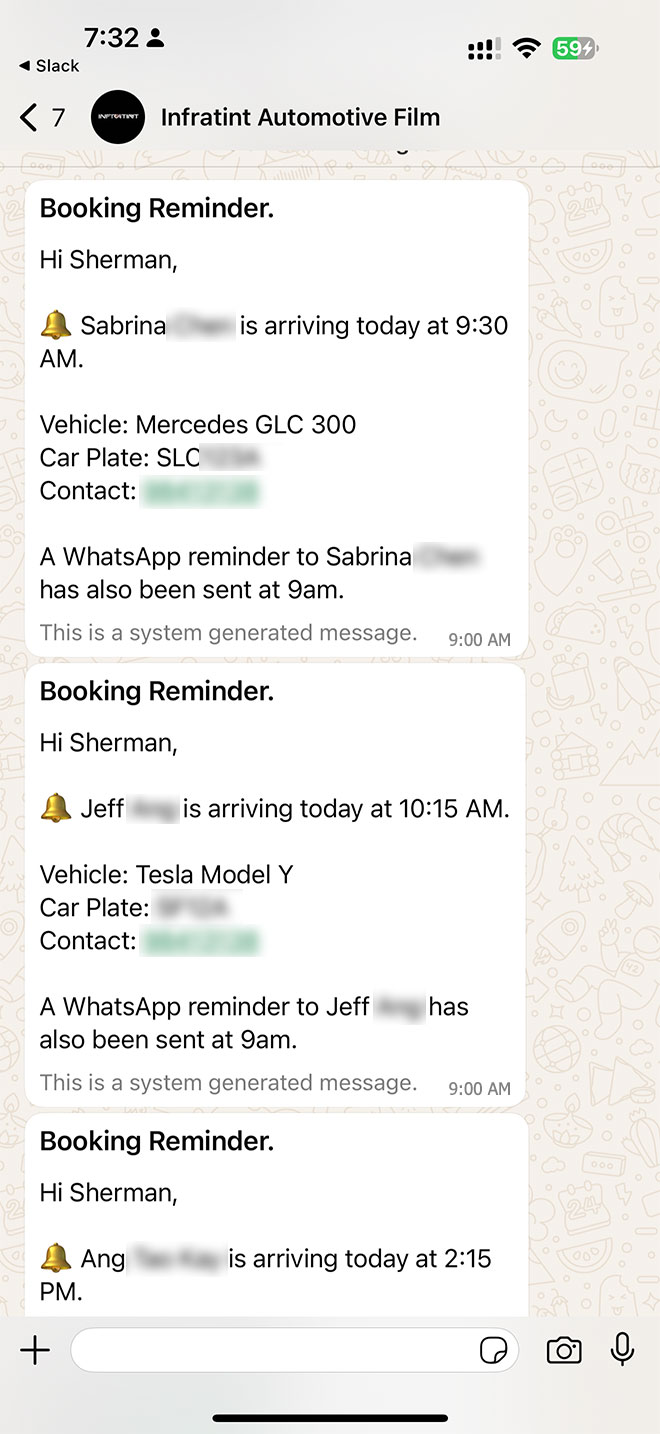
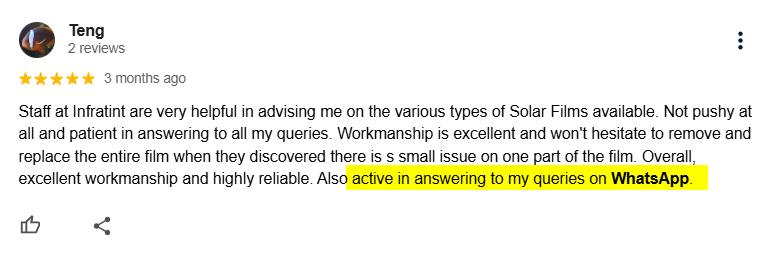
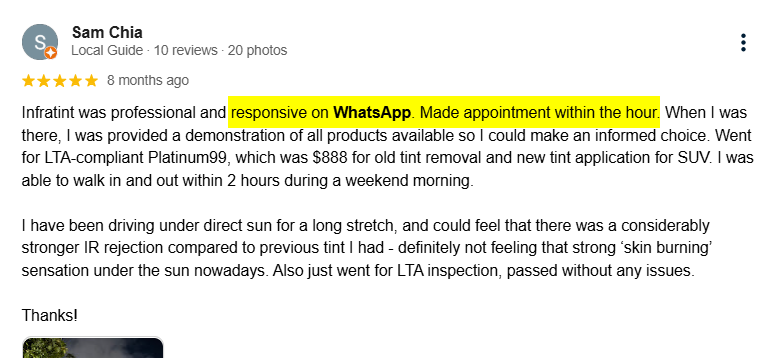
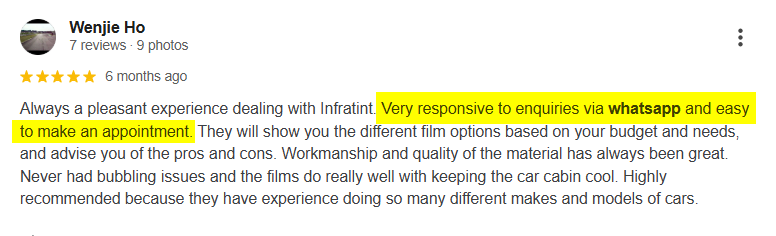
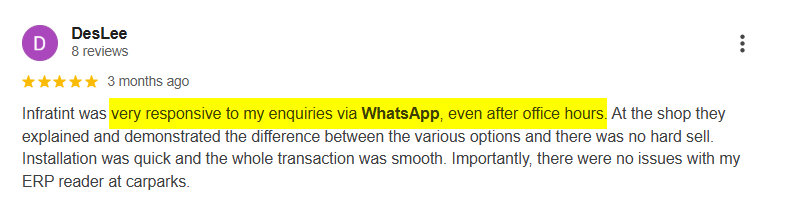
Customer reviews told the same story from the demand side. The feedback that recurred most often wasn't about the tint quality (which had always been good); it was about the rapid WhatsApp response, the after-hours coverage, and the convenience of self-booking. The operational improvements were what customers chose to write about.
Why this isn't just "deploy a chatbot"
Plenty of vendors will sell a five-person SME a chatbot. Most of those deployments stall within a quarter. The reason: a chatbot in isolation is a feature, not a system. What moved Infratint's numbers wasn't the bot — it was the bot plus the unified inbox plus the CRM sync plus the 25 lifecycle workflows plus the disciplined message strategy plus the legacy-database reactivation plus the review automation plus someone monitoring the whole thing weekly and tightening it.
| Element | Platform-only approach | Zelix Labs approach |
|---|---|---|
| Strategy | Generic templates, ship-and-forget | Custom, conversion-tested playbooks per workflow |
| Integration | Basic plug-ins, channel-by-channel | Bi-directional sync across WhatsApp, CRM, point-of-sale, calendar |
| Compliance | High ban / rate-limit risk | Proactive monitoring, template approvals, opt-out hygiene |
| Optimisation | Static campaigns | Continuous A/B testing on opens, replies, bookings |
| Support | Ticket-based, paid extras | Strategic partnership, weekly review, named operator |
Five things any service SME can take from this
- WhatsApp dominance is the floor, not the ceiling. In Southeast Asia, WhatsApp isn't "a channel" — it's the primary one. Build there first, everything else is secondary.
- Lead with utility, not promotions. The first 4–6 weeks of a new WhatsApp programme should send things people are glad to receive. Trust on the channel is earned in the boring messages, then spent in the marketing ones.
- Lean teams scale through automation, not headcount. Infratint roughly doubled output without hiring. The leverage was in removing manual touches from booking, follow-up, and reviews — not in adding people.
- Integrated data multiplies everything. WhatsApp on its own is useful. WhatsApp + CRM + point-of-sale on one timeline is a different category of useful — every workflow you build downstream gets sharper because it knows what the customer actually paid for last time.
- Respect the opt-out. Every broadcast had a one-tap opt-out. That's how you keep sender reputation high and stay clear of compliance issues. The agencies who blast hardest tend to be the ones who get rate-limited or banned within a year.
Where Infratint is now
The system is running. The chatbot handles the FAQ layer, the workflows handle the lifecycle, the manager handles the bay. Daily installs are stable in the 9–12 range with capacity to push higher once additional bays come online. The legacy database keeps generating repeat bookings every month at zero acquisition cost. The review count is still climbing.
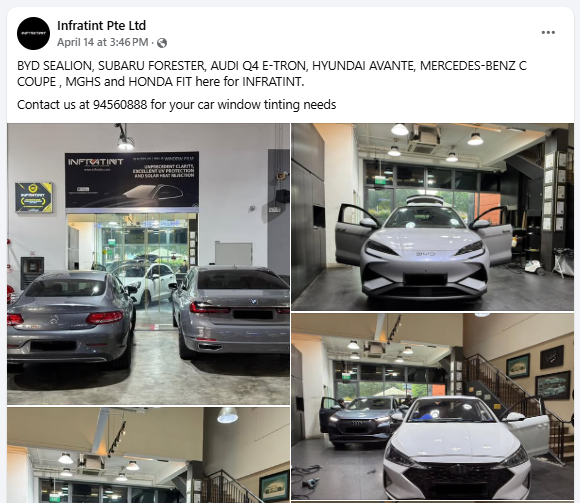
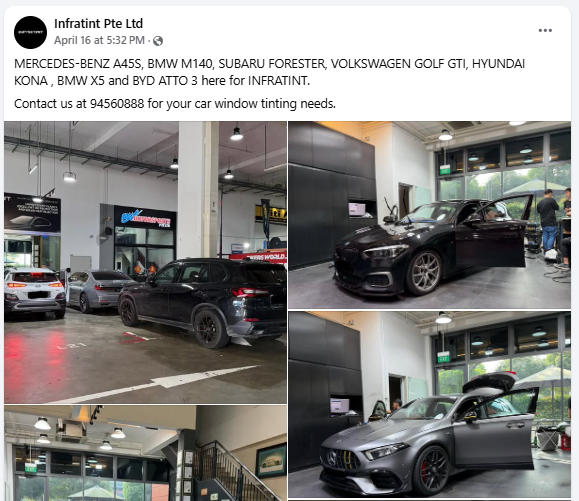
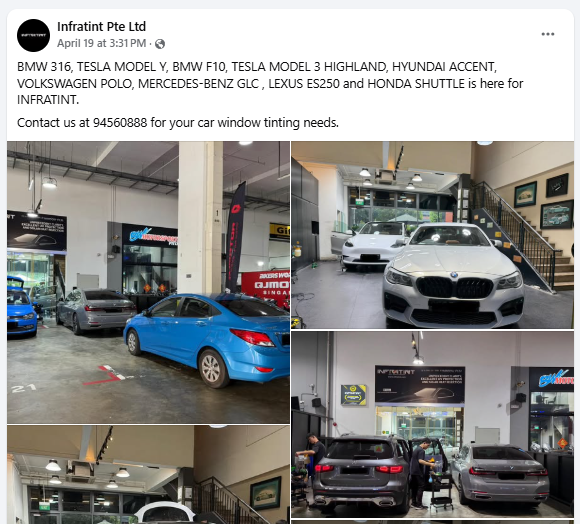
Three days picked at random from the workshop's social feed. Each post is a single day's manifest of cars going through the bay.
None of this required a bigger team or a bigger ad budget. It required moving the work from human attention to a system, then watching what the system caught and feeding it back in.
That's the case for the WhatsApp-first stack for service SMEs in Southeast Asia. Not "AI is magic." Just a sharper version of operations that were already mostly working — with the manual steps replaced by something that runs in the background while the team does the actual job.