

We have spent more than S$1.5 million (about US$1.15 million) on Click-to-WhatsApp ads for one client account in 2026 so far, starting 76,000+ conversations at a blended S$19.53 each. That spend has brought the client more than S$18 million in topline revenue. Across our portfolio we run US$5 million in WhatsApp ad spend this year, heading for US$7 million by December.
The money taught us three things. A phone number is worth far more than an email address, our WhatsApp messages consistently clear 90%+ open rates, and leads worked through our follow-up frameworks close 350% more than the same offers on email.
None of it works without the machinery behind the click: AI agents built around escalation and handoff, tool calling for bookings and rescheduling, and a CRM that stays in sync with all of it. Each part is covered below.
A Click-to-WhatsApp ad is a normal Meta ad on Facebook or Instagram, with one change. The button opens a WhatsApp chat with the business instead of sending the click to a website. Meta bills and optimises on messaging conversations started, so you are buying conversations, not visits.
We have now run that format hard for one client, and we run US$5 million in WhatsApp ad spend across the portfolio this year. Here is what the money taught us: what the channel is good at, where it catches people out, and what has to sit behind the click for any of it to work.
What did the spend actually buy?
The account behind that spend has started more than 76,000 conversations this year, at a blended S$19.53 each. Those conversations have brought the client more than S$18 million in topline revenue. At the current pace it crosses S$3 million in spend by the end of 2026.
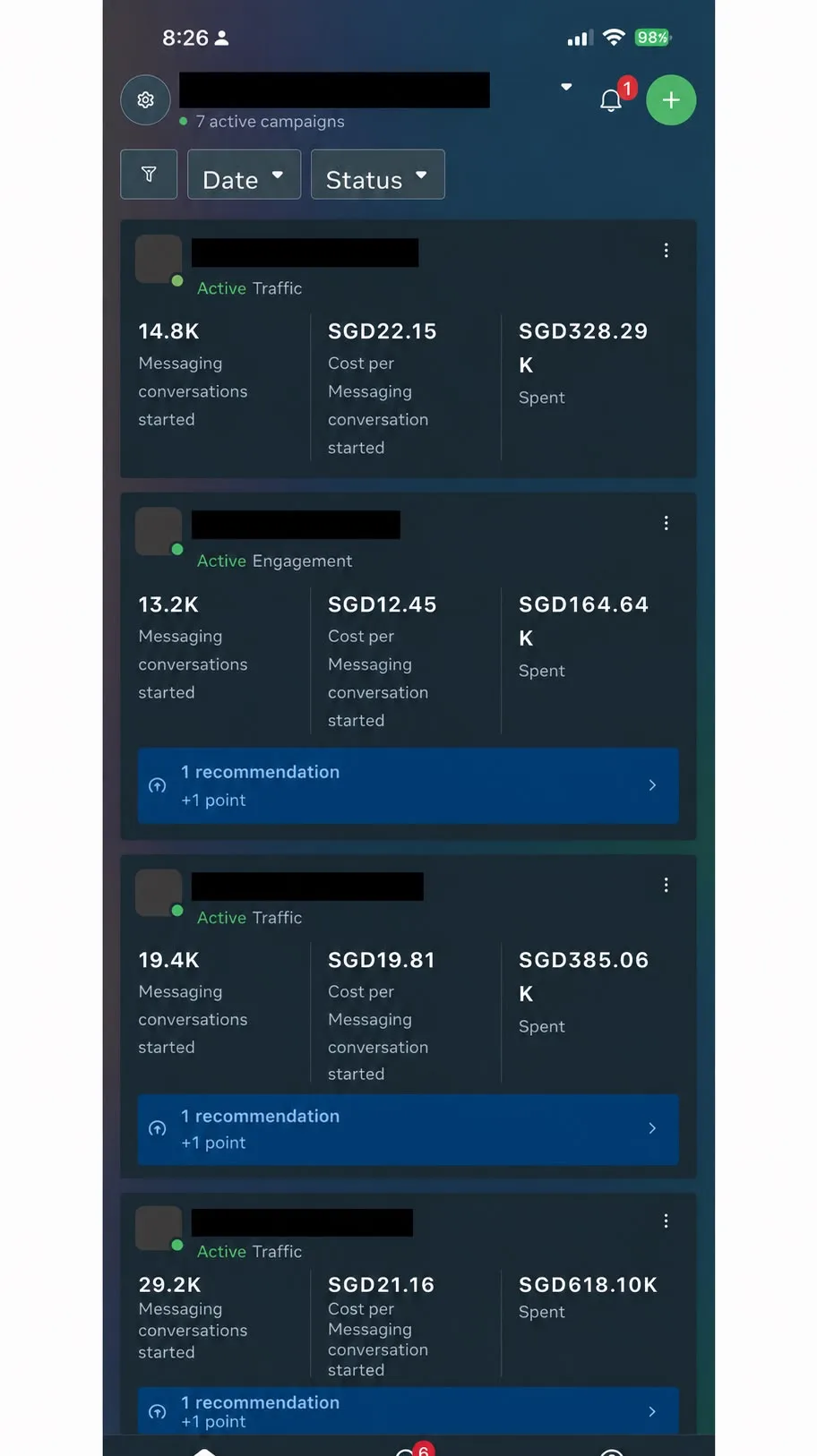
Every one of those is a real person who tapped the ad and sent a message. Not an impression, not a pageview. A live two-way thread with a phone number attached, sitting in an inbox we run.
Cost per conversation on this account runs from S$12.45 to S$22.15, about US$10 to US$17, depending on the campaign objective and the audience. Treat those as planning numbers from one high-volume account, not a promise. Your market and your offer will move them.
The uncomfortable part is what sits under that screenshot. At this scale the media buying stopped being the hard bit, because Meta's delivery does its job. The winners and losers are decided after the first message arrives, and everything below is about that second half.
Why is a phone number worth more than an email address?
A phone number reaches a person. An email address reaches a folder. When someone messages you on WhatsApp they hand over a channel tied to their identity, sitting on the phone in their pocket, that they actually read. That is what the money has been buying.

Most people keep a few email addresses, and at least one of them is the bin for marketing. Almost nobody keeps a spare WhatsApp number. The number follows the person through years and phone upgrades, and the chat history follows the number.
That history is worth money. Every past enquiry, quote and booking sits in one scrollable thread, so the next conversation starts with context instead of a cold introduction. An email from eight months ago is gone. A WhatsApp thread from eight months ago is one scroll away.
And because the customer messages first, you earn the right to reply inside the 24-hour conversation window. A click leaves you nothing. A conversation leaves you a contact you can serve, follow up and close.
What does a 90%+ open rate actually change?
Our WhatsApp messages consistently clear 90%+ open rates across client lines, and most get read within minutes. Nothing else we run comes close. The email campaigns we manage for the same businesses rarely clear a quarter of that.

That is not a vanity number. It changes the economics of everything you send after the first reply. When nine follow-ups in ten get read, how you write the sequence becomes a revenue lever. On email the same sequence is a numbers game, where most of the touches die unseen.
Speed makes it bigger. A message read in minutes lets you answer while the person is still comparing options, instead of three days after they picked someone else. Most of the closes we credit to follow-up happened because the follow-up landed while the decision was still open.
One warning, learnt with real money. That reach is earned, not free. It holds only while contacts are opted in and the cadence stays sensible, and if you abuse it, Meta's quality rating throttles your number. The full protection playbook is in how to not get your WhatsApp number banned.
The follow-up system that closes 350% more than email
Leads worked through our WhatsApp follow-up frameworks close 350% more than the same offers on email. That is four and a half closes for every one email gives you. The mechanics are not clever copy. It is timing, giving them something new each time, and knowing when to stop.

The cadence is short. One nudge the next day, one more a few days later, then stop. Pushing past two unanswered messages closes almost nothing and collects blocks instead, and those blocks cost you the whole number.
The rule that does the actual closing: every touch has to add something the lead did not have yesterday. A photo of a similar job you just finished, the answer to the question they asked, a slot that opened up. Businesses and names below are fictional.
Illustrative template with a fictional business.
And here is the one that burns lists everywhere. The bare check-in adds nothing, asks the lead to do the work, and teaches people to ignore the thread.
Illustrative conversation with a fictional business. Two touches, nothing added, nothing to reply to.
At 76,000 conversations on one account, nobody runs this cadence by hand. The follow-ups fire from automation, personalised from what the lead actually said, with a pause button on every sequence. The setup mechanics are in our follow-ups setup guide, and why follow-up matters most on long sales cycles is a guide of its own: the follow-up closes the deal.
What it cost us: a new team, trained the hard way
None of this existed in-house when the spend started. We hired and trained a new team to learn WhatsApp's infrastructure, Meta's policy surface, conversational strategy, follow-up frameworks and escalation design. Most of it was learnt by making mistakes with real money on the line.

The mistakes were ordinary, and expensive. Templates paused by Meta for negative feedback. Broadcasts sent to segments that were too cold, paid for in quality rating. Early agents that tried to answer everything and had to be reined back to what they could answer safely.
Media buying was the one thing we did not start from zero on. The team behind the account has bought $37M+ in media across their careers. The conversation layer was the new craft, and it is genuinely a different one. An ad person optimises for the click. A conversation person optimises for the ninety seconds after it.
We are still learning, and we say so on purpose. The difference now is that the mistakes are smaller, and the frameworks catch them earlier. We want to set the standard for this work, not just meet it.
How should an AI agent be structured for an SME?
The biggest lesson on structure: an AI agent's job is not to answer everything. It is to know what it is allowed to answer. One confidently wrong reply about price or availability costs more trust than a hundred good ones earn back, so how you design escalation and handoff decides whether the whole thing holds up with real customers.

The structure we now run across 300+ AI employees is simple. The agent owns first response, qualification and routine actions, inside hard boundaries. Price negotiation, complaints, anything medical or legal, and anyone who sounds confused all go to a human, and the handoff carries the full transcript so the customer never repeats themselves.
Here is the escape hatch, as the customer sees it. Done this way, the handoff builds trust instead of breaking it.
Illustrative conversation with a fictional business.
Beyond FAQs: what tool calling lets an agent actually do

An agent that answers FAQs is entry level, and that part was table stakes a year ago. The value shows up when the agent can act: check a live calendar, book, reschedule, cancel, update the CRM record, escalate with context. That acting layer is called tool calling.
Tool calling means the AI can trigger defined actions in other systems mid-conversation, like a booking system, a calendar or a CRM, instead of only writing replies. Each tool is one narrow, permissioned action against a system of record, and every call is logged.
Rescheduling is where it earns its keep. A reminder lands, and the customer replies at 10pm asking to move the slot. Without tools that becomes a sticky note for the morning shift, and usually a no-show. With tools it is done in the same minute:
Illustrative conversation with a fictional business.
The safety rule we hold every deployment to: the agent books against the real calendar, or it does not book at all. An agent that pretends to book and leaves a human to key it in later is just a slower, less honest FAQ bot.
Why the CRM, the agent and the automations must run as one system
We learnt this one the expensive way. The ad platform, the inbox, the AI agent, the calendar and the CRM cannot run as five separate tools. Every conversation has to land as a contact record with its ad source attached, every booking has to write back, and every automation has to read the same state before it fires.

When they are not wired together, the customer is the one who notices. A follow-up nudges someone the agent booked an hour ago. A promotion lands on someone in the middle of a complaint. A lead books, the ad platform never hears about it, and the campaigns keep optimising for the wrong people.
Wired properly, the loop closes. A booking kills the follow-up sequence in the same second. The CRM field the agent filled during qualification becomes tomorrow's broadcast segment. Revenue reports by campaign, so the spend gets steered by closed jobs instead of cost per click.
The outcome is what we are accountable for
Nobody buys impressions, and nobody buys conversation counts. The client is paying for booked jobs, so closed revenue by campaign is the number we hold ourselves to. Every layer underneath is there to move it.

Three layers do that work, and they only work stacked. Systems hold the state: the contact record, the ad source, the live calendar, the CRM. Automations act on it, firing the follow-up, killing the sequence the second a booking lands, building tomorrow's broadcast segment.
AI agents now sit in front of both, and not only on WhatsApp. The same agent works Instagram DMs and Facebook Messenger from the same inbox, so someone who asks on Instagram gets the same qualification, the same live calendar and the same contact record as someone who came from a WhatsApp ad.
The gaps a bigger team could not close
These four stayed open no matter how many people we put on the desk. They are structural, and they are where the agents earned their place.
- The hours nobody is on shift. Enquiries come in at 11pm and on Sunday afternoon. A human desk replies on Monday morning, and by then the customer has usually booked somewhere else.
- Volume headcount cannot follow. One account started 76,000+ conversations this year. No inbox team of a sensible size answers that many within the first few minutes, and those first few minutes decide the sale.
- Consistency on the unglamorous parts. The same qualifying questions every time, the CRM field filled every time, the ad source attached every time. People do this well on a quiet Tuesday, and badly in the middle of a promotion.
- One customer, three channels. The same person messages on Instagram, then follows up on WhatsApp. One inbox and one contact record means nobody greets them a second time as a stranger.
None of this removes the human desk. It moves it. Across 300+ AI employees the split holds: agents take first response, qualification and routine actions inside hard boundaries, and people take the escalations, the price conversations and the complaints, with the full transcript already in hand.
Where we sit in the WhatsApp ecosystem

We build on respond.io, and we are its #1 partner in Asia-Pacific. Gold partner status, and the highest client messaging volume in the region on the platform. Every framework in this article runs on that stack in production, every day.
Volume claims deserve receipts. Between January and July 2026, four of the client workspaces we run opened a combined 409,000+ conversations, each one handling between 80,000 and 138,000 over those seven months:
Conversations opened, 1 January to 31 July 2026, from respond.io analytics across four separate client workspaces. Clients anonymised; these are some of the brands we have scaled in messaging, not the whole portfolio.
We were also part of the due diligence Camber Partners ran for respond.io's Series B. We believe in the company, the platform and the people running it, and we plan to grow with them.
The platform choice matters more than most businesses expect. Campaigns end. The inbox, the contact records and the automations are what the business keeps. We put clients on the platform we would bet our own operations on, because we already do.
Where this goes next

At the current pace the flagship account passes S$3 million in Click-to-WhatsApp spend by the end of 2026. Across the portfolio we run US$5 million in WhatsApp ad spend this year, and expect to break US$7 million by December.
The spend is the visible number. The real investment is in the systems: deeper tool coverage so agents can act on more of what customers ask, tighter escalation rules learnt from every handoff, and reporting that ties each campaign to closed revenue instead of started conversations.
Questions we hear a lot
What is a Click-to-WhatsApp ad?
A Meta ad on Facebook or Instagram where the button opens a WhatsApp chat with the business instead of a website. Meta bills and optimises on messaging conversations started, so you are buying conversations, not clicks. Full definition in our glossary entry.

Illustrative ad for a fictional business. Tapping Send message opens WhatsApp with the thread already started, and that is the moment Meta bills for.
How much does a conversation cost?
On our highest-volume account, between S$12.45 and S$22.15 per conversation started, blended around S$19.53 (about US$15). Market, audience, offer and creative all move that number, so treat it as a planning range from one account, not a benchmark.
Are Click-to-WhatsApp ads better than lead form ads?
They buy a different asset. A form fill is a row in a queue. A conversation is a live thread attached to a phone number the person actually reads. The catch is that conversations arrive at all hours and expect fast answers, so the response system behind the ad decides which one wins for you.
Do you need an AI agent to run this at scale?
Past a few hundred conversations a month, a human-only desk starts missing the moments that decide the sale. Evenings, weekends, and the first few minutes after a message lands. The structure that works is AI on first response, qualification and routine actions, with humans taking over on escalation with the full transcript.
What open rates do WhatsApp messages get?
Ours consistently clear 90%+ across client lines, with most read within minutes. That reach holds only with real opt-ins, a sensible cadence, and a visible way out on every marketing send. The protection rules are in our line-quality guide.
Why respond.io?
It is where our clients' inboxes, automations and AI employees run in production. We are respond.io's #1 partner in Asia-Pacific with Gold partner status, running the region's highest client messaging volume on the platform, and we took part in Camber Partners' due diligence for its Series B.
Final words
One account, one year, and a simple hierarchy came out of it. The ad is the cheapest part to get right. The asset is the phone number and the open thread. The profit is in what happens next: follow-ups that add something, agents that know their limits, tools that act on real systems, and a CRM that keeps them all honest. That is how seven figures of ad spend became more than S$18 million in revenue.
We are still learning, and the numbers will keep correcting us. The direction is set though. By December we expect to be running US$7 million in WhatsApp ad spend on exactly the systems described here.